

By Jon Fuller, Co-Founder and Executive Director, Catalyse Europe
In recent years, conversations about climate and energy have often felt heavy.
Not because the case for action had weakened. If anything, the opposite was true. But the mood around the transition had become increasingly defensive: shaped by political backlash, high energy prices, fiscal pressures, industrial anxiety and the sense that Europe was struggling to turn ambition into delivery.
This London Climate Action Week felt different.
Not optimistic, exactly. That would be too easy a word, and probably the wrong one. The heatwave moving through London was a reminder that there is no reason for complacency. Climate change was not a distant backdrop to the week. It was in the air, in the city, in the journeys between events, and in the conversations taking place inside.
But what stood out to me was that the conversation did not feel stale or defeatist. It felt more pragmatic. More grounded. More focused on what can actually be built, financed, permitted and scaled.
For a long time, climate action has been discussed mainly through the language of targets, emissions and regulation. Those things remain essential. But they no longer fully capture the politics or the opportunity of the transition.
Energy is now a security issue. Electrification is an industrial strategy. Clean technology is a competitiveness question. Grids are not just infrastructure; they are the backbone of Europe’s future economic growth and productivity. Finance is not a side conversation; it is the difference between aspiration and delivery.
This is the argument Catalyse Europe was built to make: that the clean transition only works if it delivers on three things at once – resilience, competitiveness and decarbonisation together, not traded off against each other. Europe’s choice is not really about ambition. It is about whether it builds itself as an electrostate powered by its own electrons, its own grids, its own industrial base or stays exposed as a petrostate-in-waiting, importing both its fuel and its vulnerability.
That shift in framing was visible across the week, not in one room but in several. At Wallace Space on Monday, I chaired a closed-door session with current and former UK and EU officials. The discussion was not about whether the transition matters. It was about whether Europe is organising itself seriously enough to deliver it.
Again and again, the conversation came back to the same point: Europe has many of the right ambitions, but not yet the machinery to make them work together. Energy policy, industrial strategy, finance, trade and security are still too often treated as separate files. In reality, they are now parts of the same project.
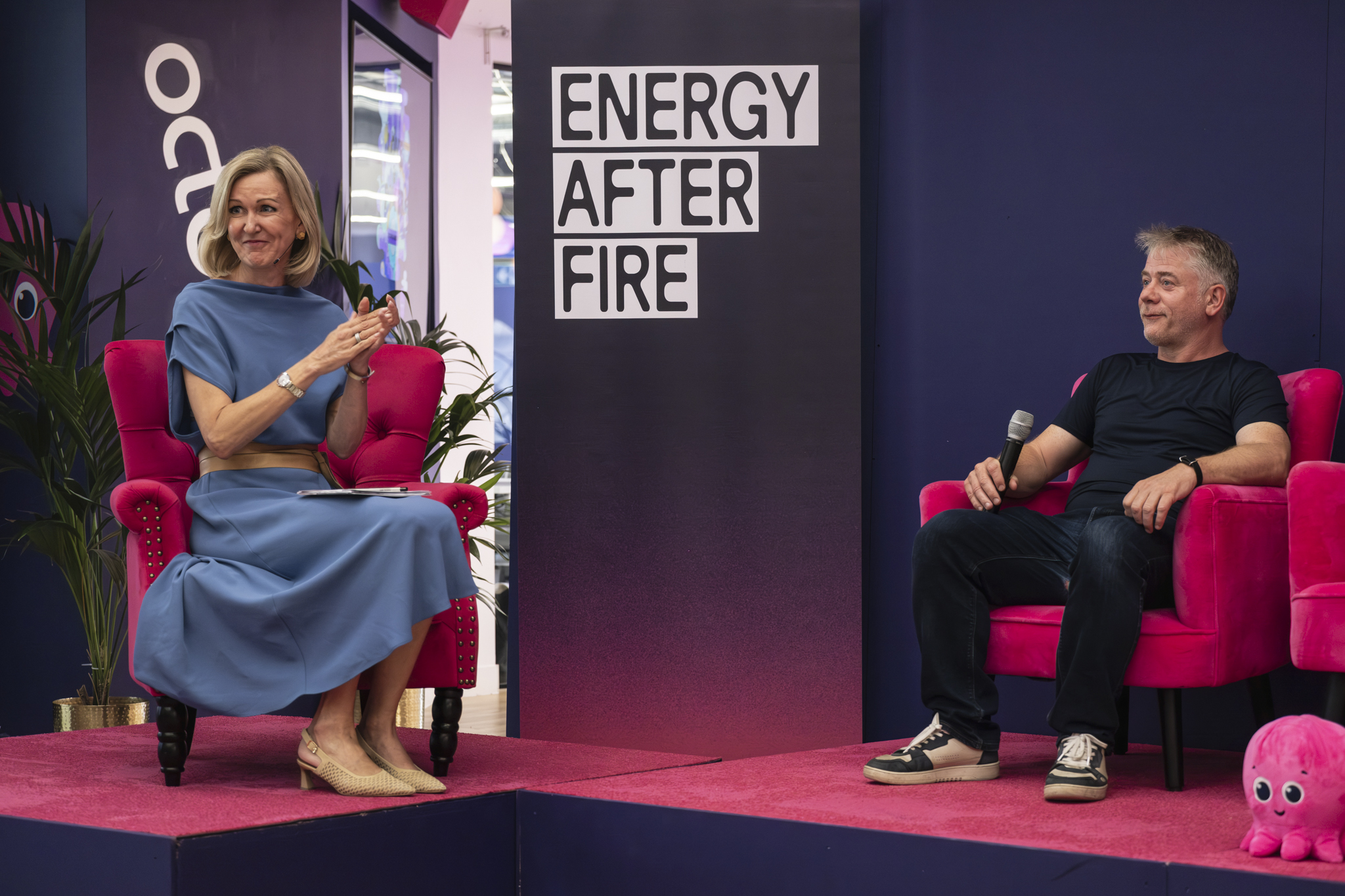
That same sense also came through at Energy After Fire, which Catalyse Europe was proud to co-host at Octopus Energy’s headquarters. The mood there was not one of defensive climate politics. It was about builders, investors and enablers of the electrified economy that is already emerging.
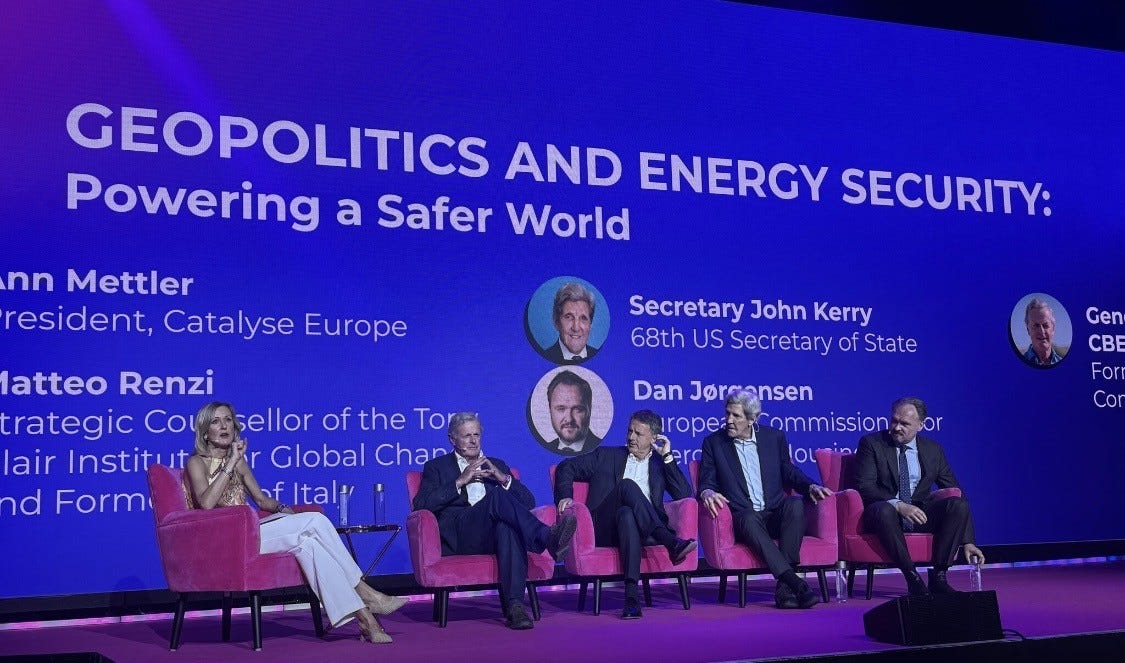
Our President, Ann Mettler, also moderated a panel with John Kerry, General Sir Richard Shirreff KCB CBE, Matteo Renzi, Strategic Counsellor at the Tony Blair Institute for Global Change and former Prime Minister of Italy, and Dan Jørgensen, European Commissioner for Energy and Housing, at the Octopus Energy Battersea summit. The panel made a related point to a much larger audience: energy security and industrial strategy are now part of the same conversation, not two separate ones.
These points matter because the transition is no longer only a story about what must be reduced. It is increasingly a story about what must be built.
New energy supply is being dominated by renewables and electrification. Clean technologies are moving from the margins into the centre of industrial competition. The question is not whether this shift is happening. It is whether Europe can move quickly enough to capture the value, build the infrastructure and shape the terms of the next industrial era.
There was a clearer recognition that the climate and energy agenda cannot survive if it is framed only as a burden, a cost or a set of constraints. It has to be understood as a route to greater resilience, stronger industries, lower exposure to fossil fuel volatility and a more secure European economy.
Europe is still exposed. Its energy system remains vulnerable to external shocks. Its grids are not being built fast enough. Its industries face high costs and fierce global competition. Its savings are not yet being channelled at sufficient scale into the infrastructure and technologies it says it needs.
But there is now a clearer path through those challenges: electrify faster, build grids faster, use public policy to unlock private capital, treat clean industry as a strategic asset, and connect climate policy to the economic and security concerns that define this moment.
The heatwave gave London Climate Action Week a certain moral clarity. It reminded us why delay is dangerous.
But the conversations inside the rooms offered something else: not optimism, but a way forward.
For Catalyse Europe, this is exactly the space we were created to work in: connecting energy, industry, finance and geopolitics; bringing together people who do not always sit in the same rooms; and helping turn the clean transition from a set of ambitions into a practical strategy for European resilience and competitiveness.
The climate and energy conversation is changing because the world around it has changed.
The task now is to make sure Europe changes with it.