
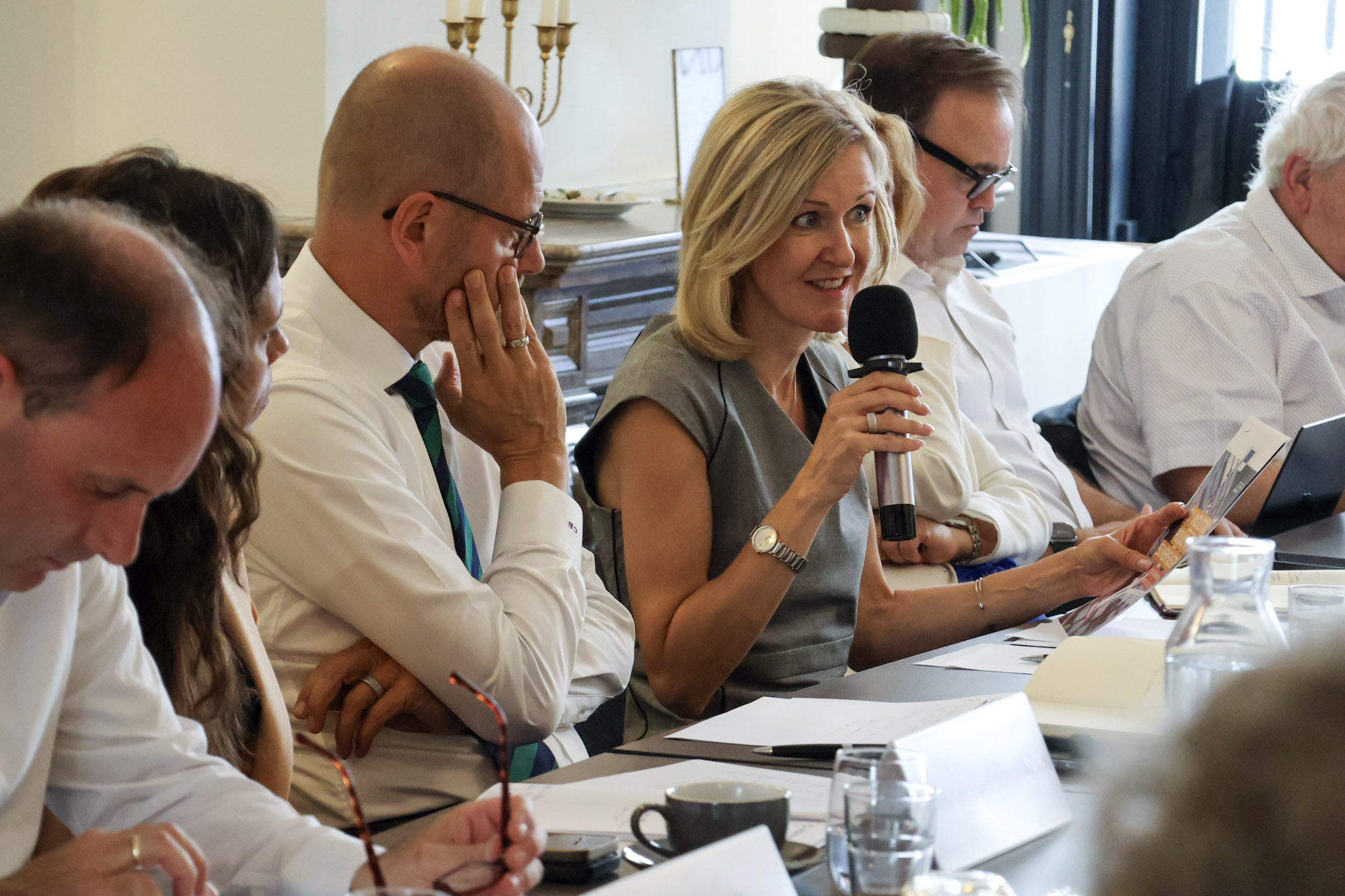

On 29 June in Brussels, Catalyse Europe, alongside Institut Montaigne, the Berlin Jacques Delors Centre and the Energy Resilience Leadership Group, had the privilege of convening senior voices from EU institutions, industry, finance and research under the theme Made in Europe, Made with Europe: Industrial Strategy and Energy Resilience in an Age of Geopolitical Disruption.
The practical question running through the discussion was how Europe can build the clean industrial capacity it needs while still drawing on the investment, partnerships and supply chains required to move at speed.
Ann Mettler, President of Catalyse Europe, Christian Bruch, CEO of Siemens Energy, and Kerstin Jorna, Director-General of DG GROW, among others, gave key insights on how to design policy to address Europe’s electrification, security and competitiveness objectives in a time of geopolitical change.
Catalyse Europe was pleased to be joined by MEPs Jeannette Baljeu and Thomas Pellerin-Carlin, alongside Andreas Schwarz, Head of Cabinet to Commissioner Zaharieva, Barbara Glowacka, Energy and Competitiveness Adviser in the Cabinet of European Council President António Costa, and a strong group of industry, policy, finance and research leaders.
The discussion examined the choices and trade-offs now facing Europe’s industrial base: local content, foreign investment conditionality, batteries, electric vehicles, clean technology supply chains and synthetic fuels as a case study for how industrial strategy translates into price.
Getting the IAA right is also the focus of two new Catalyse Europe memos.
The first looks at making the overall framework work in practice. The IAA should be judged by whether it actually helps companies build and scale clean industry in Europe. Extra complexity, unresolved definitions or misalignment with other EU legislation would make that harder.
The second focuses on the foreign direct investment conditionality provisions attached to the IAA. Europe needs foreign investment to scale its clean industrial base, while ensuring that investment builds European capacity and does not create new strategic vulnerabilities. This said, it is also critical for the legislative framework to facilitate strategic partnerships with third countries to develop new, diversified clean supply chains.
Together, the memos set out a practical approach to the IAA: coherent with the wider EU policy agenda, workable for industry, and clear about where Europe needs to build, where it needs partners, and what conditions should apply.