

Catalyse Europe, together with the European Initiative for Energy Security (EIES), Transport & Environment and Loom Strategy, has launched the Backbone Coalition, a new initiative focused on strengthening Europe’s battery value chain.
The Coalition launches with Europe’s Electric Backbone: A Strategy for the Future of Batteries, a new briefing paper setting out the strategic case for building a competitive and resilient European battery sector.
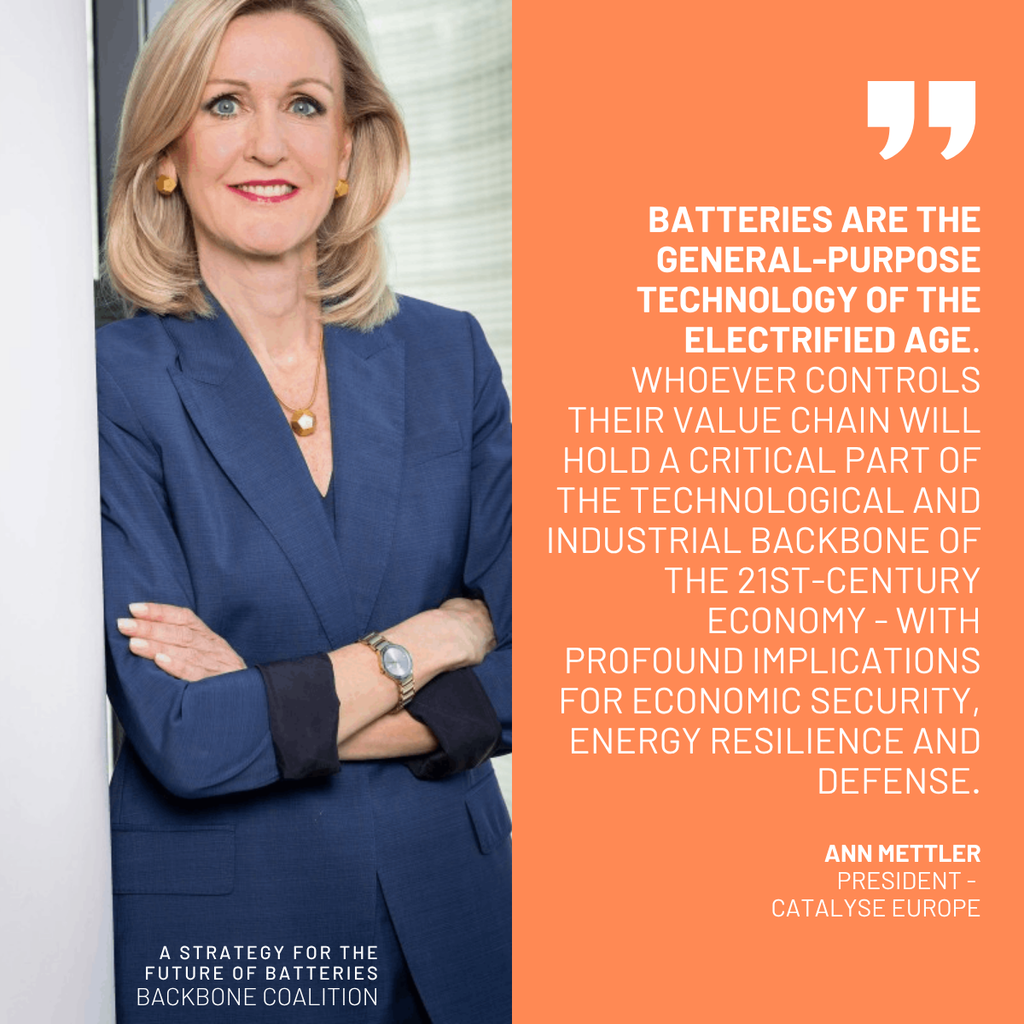
Batteries are becoming the backbone of Europe’s future energy system, industrial base and defence readiness. Europe is embedding them across strategic parts of its economy at record pace, but is not building the industrial capacity needed to supply them at the same rate.
Europe’s Electric Backbone examines the security and economic exposure this creates and sets out what the EU can do over the next three years to strengthen Europe’s battery value chain and support competitive production at scale.
Batteries are a strategic gateway technology for Europe
Batteries are no longer primarily an automotive technology. They are a foundational part of the electric technology stack underpinning electricity grids, industrial electrification, data centres and defence.
Europe therefore needs to retain meaningful capability across the battery value chain, including cells, midstream materials, manufacturing equipment and software. The objective is not full reshoring, but a resilient European backbone that reduces exposure to geopolitical coercion, supply disruption and cyber or operational risk.
The cost of inaction is higher than the cost of building resilience
Without a viable business case for European battery production, capital, skills, research and innovation, and manufacturing capacity risk moving elsewhere, while Europe becomes increasingly dependent on concentrated foreign supply chains.
That would weaken Europe’s ability to shape standards, procurement and industrial development, while making future dependencies harder and more expensive to reverse.
Europe will not always compete on the lowest unit cost. But the remaining gap should be understood as part of the price of maintaining strategic agency, industrial capacity and security.
Europe needs support that is fast, focused and at scale
Europe is not starting from zero. It has a strong research base, significant industrial expertise and one of the world’s largest internal markets. The challenge is turning those assets into competitive scale.
The Coalition is calling for action in five areas:
- Make production support bankable and mobilise private capital. Introduce more predictable, output-based production support and use public funding to reduce risk and unlock private investment.
- Create stronger demand for European-made products. Ensure measures such as the Industrial Accelerator Act create a genuine incentive to invest and produce in Europe.
- Secure the whole battery value chain. Extend support beyond cells to strategically important midstream materials, processing and recycling.
- Maintain focused support for innovation. Continue investment across current and next-generation chemistries, manufacturing equipment, digitalisation, recycling and raw-material processing.
- Strengthen trade defence and defence-industrial security. Use trade-defence tools where unfair competition threatens European capacity and strengthen security criteria for batteries used in critical energy and defence systems.
Without these measures, Europe risks losing industrial capability that will be much harder and more expensive to rebuild later.
About the Backbone Coalition
The Backbone Coalition brings together Catalyse Europe, EIES, Transport & Environment and Loom Strategy to build support for the policies and investment needed to scale a competitive European battery sector.
The Coalition sees batteries as a strategic gateway technology for Europe, underpinning secure electricity grids, industrial capacity and defence. It will work to reduce Europe’s exposure to concentrated supply-chain dependencies, strengthen European and trusted allied production, and ensure public policy creates the demand, investment conditions and resilience needed to compete in an increasingly electrified economy.