Across European policy debates, the clean energy transition has been increasingly framed not only as a decarbonisation pathway but as a central pillar of industrial competitiveness and economic security. The ongoing conflict in the Middle East and its impact on energy flows and prices as well as the resulting effects on Russian energy exports and the US lifting sanctions on banned Russian energy exports illustrates once again the interlinkage between security and energy concerns for Europeans. This evolution is also particularly salient as Ukraine enters now its fourth year of war in which targeting energy infrastructure has become the latest most effective weapon for the Russian side. Clean energy deployment, electrification, and domestic technology capacity are now widely recognised by policymakers as determinants of resilience, security and strategic autonomy. It is also a factor of cost stability and competitiveness as the EU continues to navigate geoeconomic turmoil, particularly vis-à-vis both the United States, whose trade posture raises the prospect of further tariffs, and China, whose dominant position across clean energy supply chains and critical raw materials introduces exposure to potential export controls.
Yet translating this expanded narrative into coherent policy action remains uneven. Prolonged negotiations and delays affecting key initiatives, including the Industrial Accelerator Act, the Clean Energy Investment Strategy and broader clean energy financing instruments, as well as persistent tensions around “Made in Europe” provisions, illustrate the difficulty of reconciling strategic ambitions with political and economic constraints. Policymakers continue to navigate a complex landscape shaped by concerns over protectionism despite evolving global trade dynamics. Finally, these pressures are compounded by divergent Member State preferences and the persistent challenge of calibrating the balance between supranational coordination and national policy autonomy.
However, among these policies debates, one essential dimension of the clean energy transition that remains insufficiently integrated into European energy and industrial planning is the transformation of labour markets. This imbalance between deployment targets and their labour-intensiveness risks obscuring both the scale of the opportunity and the magnitude of the adjustment required. Clean energy systems, by their nature, rely on value chains that are considerably more labour-intensive than traditional fossil-fuel extraction and processing activities. Expanding renewable generation, modernising electricity grids, deploying storage technologies, and transforming industrial processes require a broad spectrum of skills across construction, manufacturing, engineering, digital services, and system integration and expansion. The transition therefore represents a powerful potential driver of job creation across Member States but are also associated with risks.
First, without proactive labour-market planning, the European Union may face structural shortages of the workforce required to deliver its clean energy deployment objectives. Recent research indicates that skills gaps and labour shortages are already affecting hiring capacity, particularly in construction, energy production and distribution, and transport. As investment and deployment accelerate, these pressures are likely to intensify. Structural factors affecting this challenge such as insufficient labour mobility across sectors and participation in training programs are not yet correctly addressed.
Second, Europe risks failing to fully capture the growth, reindustrialisation, and employment opportunities associated with the transition, leaving value creation to other global powers. Projections suggest that clean energy employment worldwide is expected to more than double by 2050, increasing from an estimated 57 million to 134 million jobs. International partners and competitors are already positioning themselves to capture these expanding value chains. In the United Kingdom, for example, recent announcements by major grid firms signal high recruitment dynamics, reflecting both accelerating deployment and growing industrial ambition.
It is against this backdrop of industrial, economic, and labour market transformation that Catalyse Europe, in partnership with Evolved Energy Research, conducted a modelling exercise to assess the employment implications of the energy transition across EU Member States. In a context characterised by accelerating electrification, persistent unemployment, and widening skills gaps, the analysis evaluates the extent to which the transition can serve as a structural engine for job creation.
The study indicates that, under conditions of coherent policy design and a technology-inclusive transition pathway, the clean energy transition has the potential to generate up to 4.65 million net new jobs across the European Union. These employment effects emerge progressively and unevenly, shaped by investment patterns, sectoral dynamics, and workforce availability.
Our recent memo demonstrated that the employment gains associated with the clean energy transition are likely to unfold in two distinct but interdependent waves. The first wave is primarily driven by demand-side activities, including electrification, building renovation, and infrastructure deployment, while the second wave reflects longer-term industrial expansion across manufacturing, clean technology production, and energy supply chains. This sequencing highlights the importance of policy planning that recognises the temporal and structural interdependencies between those two waves of job creation.
Building on these findings, we will now shift focus from aggregate employment effects towards sectoral dynamics. The objective is to provide policymakers — at both EU and Member State levels — with a clearer understanding of where jobs are most likely to materialise geographically, which sectors will drive employment growth, and where workforce constraints may prove most binding therefore demanding specific training and reskilling programs for workers.
Our analysis identifies several leading categories of jobs with particularly strong job creation potential, notably construction, manufacturing and clean energy supply chains, as well as grids and energy systems expansion. Importantly, different technology deployment pathways generate distinct skills demands, training requirements, and regional workforce needs. The scale of the projected workforce transformation is potentially considerable. The study indicates the creation of 4.65 million of net jobs by 2050. The required skilled workforce does not yet exist at sufficient scale, implying the need for sustained investment in education, vocational training, reskilling programmes, and broad attention from policymakers. Crucially, the study also shows labour-market effects differ across Member States. Variations in workforce composition, industrial specialisation, training systems, and regional economic structures mean that the transition will unfold unevenly across the Union. National planning frameworks therefore become indispensable. While EU-level coordination can provide strategic guidance and support, workforce transformation strategies must ultimately reflect national labour-market realities.
When looking at how policymakers can effectively unlock the sectoral job creation potential of the clean energy transition, the EU requires further harmonisation efforts to create the conditions for cross-border energy integration, workforce mobility, alongside a stronger alignment between industrial strategies and workforce planning frameworks. At the same time, EU coordination must preserve sufficient flexibility for Member States to design nationally adapted strategies. Indeed, workforce transformation pathways must reflect Member States’ specific economic structures, clean energy deployment capacities, technology choices, and labour market characteristics. Third, EU policymaking should more broadly support job creation by strengthening governance frameworks that better integrate and fund clean technology companies and their wider ecosystems. Closer coordination between industry, training systems, and public authorities will be critical to align investment, skills development, and deployment needs.
The Three Main Sectors of Job Creation
1. Construction
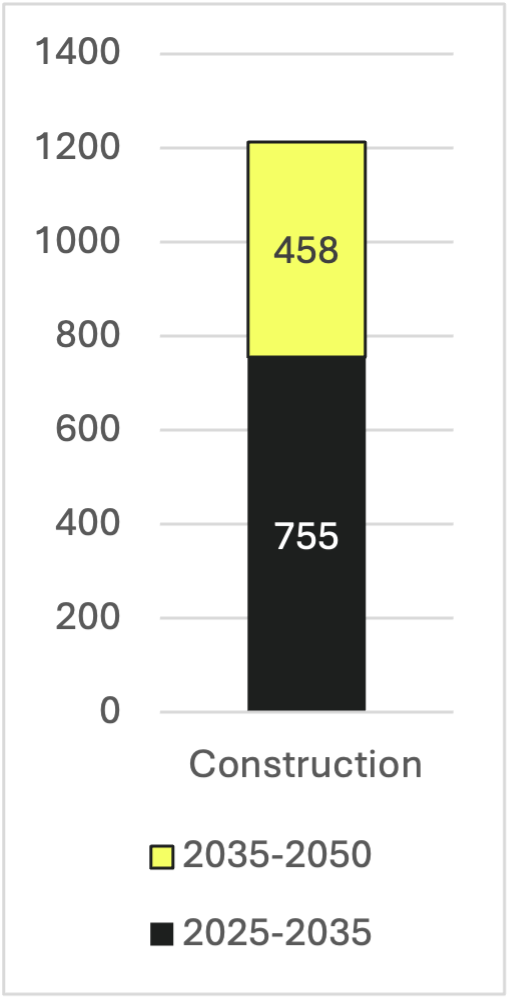
Construction emerges as the single largest driver of new employment. The modelling projects an additional 1.21 million jobs by 2050, compared to an estimated 13.8 million construction jobs EU-wide in 2024, representing an increase of approximately 8.7%.
Whether it’s building clean technology energy facilities, upgrading existing infrastructure, or retrofitting homes and commercial buildings for energy efficiency, nearly every clean energy investment begins with a constructive crew on-site. This is true for both demand- and supply-side activities, making construction a critical bridge between sectors.
Construction jobs are inherently local, labour-intensive, and closely tied to domestic economic activity. As such, they anchor clean energy investments within regional economies, reinforce skilled trades, and strengthen the EU’s infrastructure value chains.
2. Manufacturing and clean energy supply chains
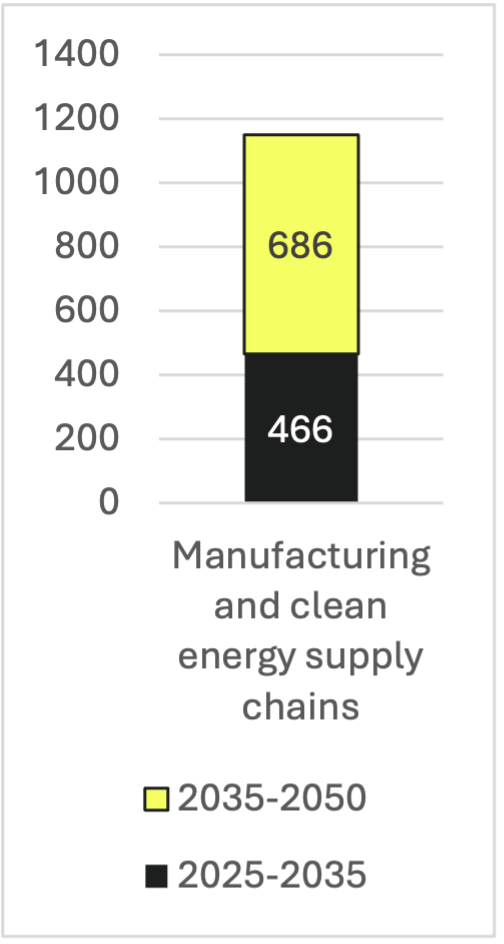
Manufacturing and clean energy supply chains constitute the second major engine of employment growth, with particularly strong dynamics projected in parts of Central Europe. As deployment scales, need for raw materials processing, component production, fabrication capacity, and specialised engineering services will increase.
Employment growth spans a wide range of activities, from established renewable technologies such as wind turbine components and solar equipment to emerging clean technologies production, including heat pumps, EV charging infrastructure, hydrogen electrolysers, and transmission hardware. The modelling highlights particularly strong growth potential in emerging technologies, including direct air capture (approximately 0.25 million net jobs by 2050) and hydrogen electrolysis (approximately 0.21 million net jobs).
This sector also represents a key destination for workers transitioning from fossil fuel industries, provided that sufficient domestic manufacturing capacity is developed. Importantly, the geographic distribution of job creation will depend heavily on industrial location decisions. Whether clean technology production scales within Europe or shifts abroad will significantly shape labour-market outcomes.
3. Grids and Systems Expansion
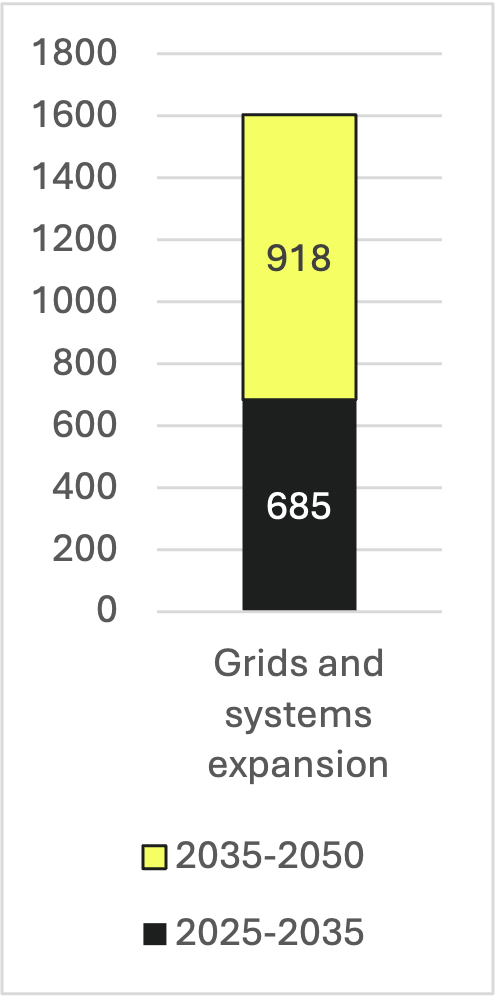
Grids and energy systems expansion form the third pillar of employment growth and represent a structural prerequisite for the transition itself. Electrification across transport, heating, and industry is fundamentally dependent on the availability of a modern, robust, and resilient electricity network and will not be technically feasible without it, irrespective of the chosen technology mix.
Meeting these requirements will necessitate large-scale investments in transmission and distribution infrastructure, generating more than 1.5 million jobs by 2050. These roles span grid planning, engineering, construction, maintenance, and digital system integration.
Three Key Macro Dynamics
Beyond sectoral specificities, the modelling highlights several structural dynamics that must be incorporated into a more holistic approach to industrial and workforce planning.
1. Transition from carbon-intensive sectors
The clean energy transition will not only generate employment gains but also induce losses in carbon-intensive industries, particularly across fossil fuel extraction and brown energy sectors such as coal and gas. Anticipating these shifts is therefore critical. While clean energy value chains are generally more labour-intensive than extractive fossil fuel activities, employment gains at the aggregate level do not automatically translate into smooth transitions for individual workers. The adjustment process will unfold unevenly, and worker-level impacts must be carefully managed through targeted reskilling and redeployment strategies.
2. Structural shifts in labour demand
At the same time, the modelling points to a tangible risk of labour shortages in the sectors driving employment growth. Construction, manufacturing and clean energy supply chains, as well as grids and systems expansion, are characterised by strong skills requirements. Yet Europe’s current labour market composition remains heavily concentrated in services and information-based activities. This creates a structural mismatch between where workers are presently located both sectorally and geographically and where labour demand is expected to surge. Without deliberate policy intervention, workforce availability may become a binding constraint on deployment and industrial expansion.
3. The importance of Member State specificities
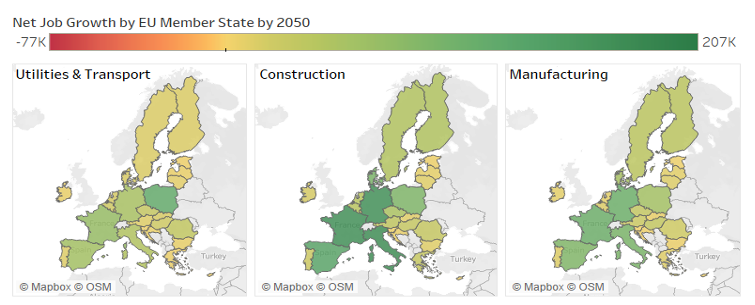
National contexts will play a decisive role in shaping employment outcomes. Differences in energy infrastructure, industrial structures, workforce composition, and training systems will influence not only the scale of job creation but also its timing and sectoral distribution as outlined in Figure 2. Some countries are projected to lead in absolute job creation, while others will experience sharper relative employment gains due to smaller starting labour markets. Crucially, these dynamics vary significantly across sectors.
The modelling indicates that France, Germany, Poland, Spain, and Italy each generate more than 0.45 million new jobs by 2050. Meanwhile, smaller Member States such as Denmark, Czechia, and Finland display particularly strong relative employment growth, reflecting concentrated investments in clean energy deployment and grid infrastructure. At the lower end, countries including Malta, Cyprus, and Luxembourg still register net employment gains, albeit at more modest scales, largely constrained by land availability and population size.
EU Policy Implications 2026 to 2030
1. Integrating EU Workforce Planning into EU Industrial Policy
While the EU is explicitly tying its industrialisation with decarbonisation and competitiveness objectives, it must also focus on preparing the workforce to meet emerging clean energy demands.
The Clean Industrial Deal has already taken a step in that direction, by introducing its Union of Skills, a strategic initiative designed to equip the workforce with the necessary skills. The initiative focuses on reskilling, vocational training, skills mobility, and attracting talent while aligning education systems with industrial needs through initiatives like the Pact for Skills and micro-credentials. However, while this represents a significant recognition of the need to embed workforce development into the EU’s industrial strategy, more can be done in the future. Moreover, the EU should scale-up existing programs, and prioritise the integration of large-scale upskilling and reskilling initiatives in industrial policies, particularly in transitioning regions, where energy-intensive industries are currently based. Expanding programs like the Pact for Skills to facilitate worker mobility and integrating workforce targets into Member State industrial strategies will ensure a smooth labour transition.
2. Enabling Member-State Specific Clean Energy Strategies
The role of the European Union should be to provide an enabling framework, while allowing Member States to define, through national strategies, the timing and structure of employment growth in line with their regional labour market and sectoral specificities. Attempting to impose detailed employment or sectoral targets through a top-down approach risks disconnecting policy objectives from on-the-ground realities, including differences in workforce composition, industrial traditions, and labour market practices. Technology inclusiveness and policy flexibility are therefore central to this approach.
3. Supporting Clean Energy Job Creation through Stronger EU Backing of Clean Tech Ecosystems
Maximising clean energy job creation requires a broader and more coherent EU strategy to support clean technology companies across their full development cycle. While Europe performs strongly in research and early-stage innovation, many clean-tech firms encounter significant obstacles when moving from demonstration to industrial scale and commercial deployment. Fragmented markets, regulatory inconsistencies, uneven access to finance, and limited cross-border deployment pathways continue to constrain growth and prevent promising technologies from reaching maturity within the European market.
Addressing this gap demands a more expansive understanding of innovation, not merely as technological invention, but as the complete process from research and prototyping to scaling and industry-wide deployment. Bridging this transition requires stronger institutional coordination, improved alignment between funding instruments and industrial strategies. Instruments such as the European Innovation Council and the Scale-Up Europe Fund, alongside regulatory reforms including permitting simplification partially addressed in the proposed Industrial Accelerator Act represent important steps forward. However, financial and regulatory tools alone will not deliver systemic transformation.
A durable shift will depend equally on governance culture. Public authorities must focus on enabling, de-risking, and coordinating rather than micromanaging or discouraging industrial risk-taking. Clean-tech companies ultimately design, manufacture, and deploy the technologies that underpin the transition, policy frameworks must therefore create the conditions for them to scale effectively within Europe. This implies closer integration between research ecosystems, industrial actors, and policymakers, as well as more interdisciplinary and sequential planning.

Dorine Buchot
Research Manager