
Reflections from Schloss Elmau
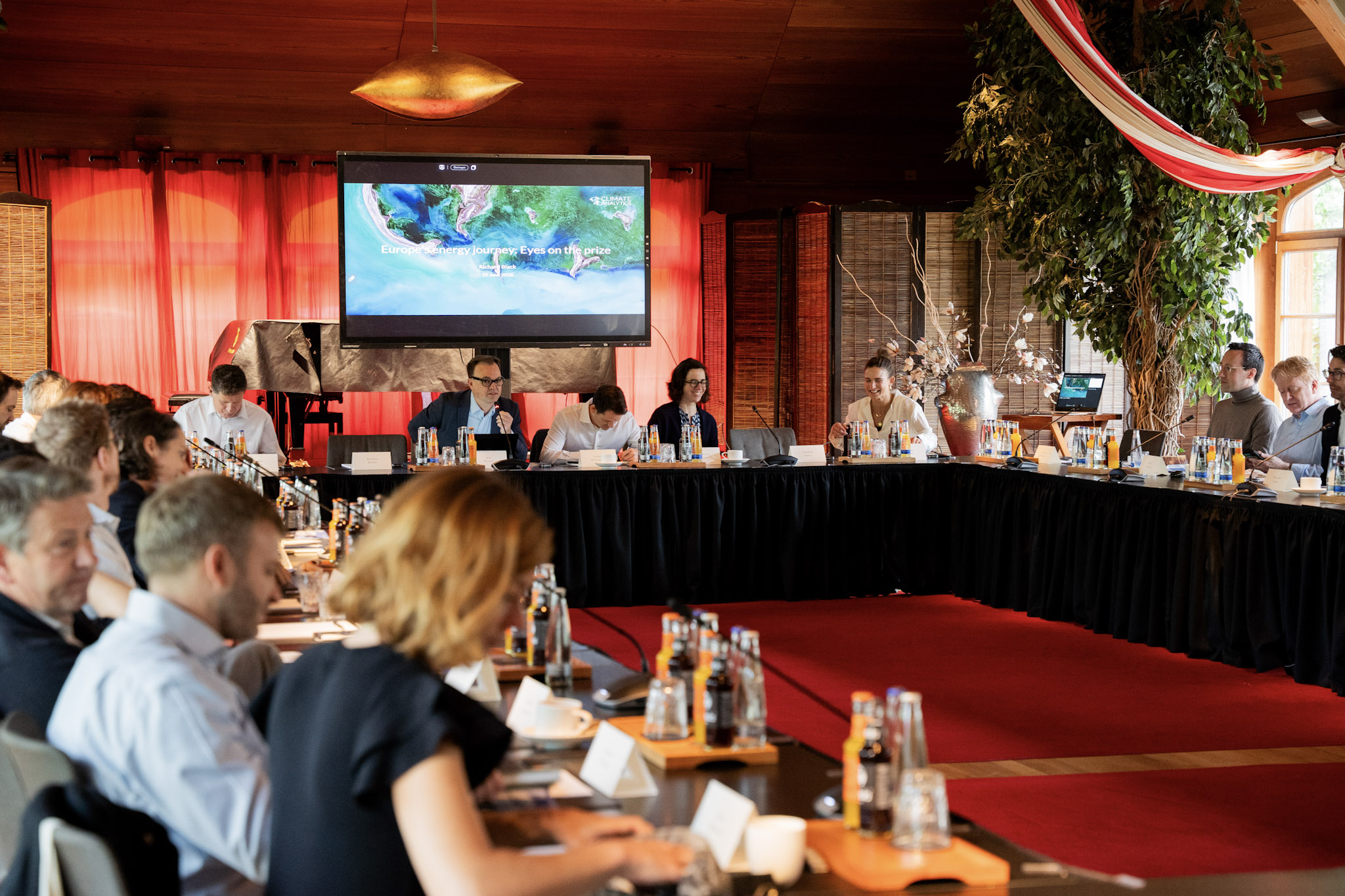
Last week, over fifty people gathered at Schloss Elmau in Bavaria for Catalyse Europe’s first retreat. The weather was grey and overcast. The conversations were certainly not.
I wanted to take a moment to share what we discussed because the issues this group spent two and a half days wrestling with are not abstract policy questions. They are the issues that will determine whether Europe’s clean energy transition succeeds or stalls. In many ways, this was also the launch moment of Catalyse Europe.
What changed in the room
We spent two and a half days on the questions that sit at the intersection of Europe’s energy future, its industrial strategy, and its geopolitical position. The sessions covered the contested 2035 energy mix, the emerging middle-power coalition agenda, a trade war scenario exercise, the private finance gap, the political fragility of carbon pricing, and the fiscal and monetary limits on public investment.
What struck me was not any single argument. It was a shift in the conversations’ overall framing.
We all know that the energy transition and the climate agenda are under significant political pressure. From geopolitics, from fiscal constraint, from political headwinds. By the end, that frame had quietly inverted. The more durable argument, which emerged most clearly in the sessions on geoeconomic resilience and private finance, is that the energy transition is now primarily a story about European security, economic growth and industrial competitiveness. Climate may be the long-term destination, but it is no longer the driver. The Iran conflict, which has sent European energy prices surging once again, has reminded governments that the dependence they promised to eliminate remains largely intact.
This reframing matters. It changes what policies are defensible, which coalitions are possible, and which investment arguments land with time poor politicians and finance ministries who are unwilling or unable to take step back from well-intentioned processes to see the bigger picture. Get it right and the energy transition becomes what it should always have been presented as: a triple win for resilience, competitiveness, and decarbonisation together.
Three things the retreat clarified
The grid problem is worse than the headlines suggest. Regardless of where you stand on clean firm power versus renewables, Europe is not building the transmission and distribution networks it needs at the required pace. The constraint is not primarily financial. It is the permitting and governance frameworks that add years to projects that should take months. Ultimately, this is a political failure dressed up as a technical and financial one.
Carbon pricing is in more trouble than its defenders will admit. Having Jos Delbeke, who spent twenty years building the EU ETS, in the room made the conversation about ETS2’s political fragility particularly honest. Ten member states wrote to the Commission in March calling carbon regulation an existential risk. The ETS2 extension to buildings and transport was already delayed to 2028. The conclusion the room reached was not that carbon pricing is finished, but that any post-2030 climate architecture that still relies on it as the primary instrument is not going to survive the politics. A shift to a portfolio approach — standards, industrial policy, procurement, and border measures alongside carbon pricing — is now a practical necessity, not a theoretical preference.
Finally, and perhaps most important of all, the private finance gap continues to be a big structural problem, and the current policy response is not equal to it. The Commission’s own Clean Energy Investment Strategy estimates energy investment must reach €660 billion a year by 2030 — nearly three times the average of the past decade. We know the vast majority of it must come from private capital when most of the major European economies have debt to GDP ratios in excess of 100%, and the demands on the public purse for healthcare, defence, education, transport and welfare continue to grow. And yet European pension funds and insurance companies, sitting on tens of trillions of euros in assets, are not moving at scale into European clean infrastructure because the risk-adjusted returns do not compete.
Until the Savings and Investment Union creates genuinely integrated capital markets across the EU, European pension savings will continue to flow to the United States and global markets rather than building the infrastructure Europe says it needs. That is not a market failure. It is a policy failure and absent sufficient political will to change it, we will continue to lag behind others.
What this means for Catalyse Europe
Catalyse Europe is four months old. Ann Mettler and I started this organisation because we believed – and still believe – that the gap between where European policy analysis is and where European policy action needs to be is too wide, and that closing it requires better connections between the people doing the thinking, the people making the decisions, and the people deploying the capital. Our first retreat was the clearest test of that thesis we have had so far.
I came away with a stronger conviction that our thesis holds, and with a more sober view of how hard the work is. The connections Europe needs to make – between energy, trade,
finance, defence, and geopolitics – run across institutional boundaries that were specifically designed to keep these issues separate. Overcoming them is not a matter of good will. It requires deliberate, sustained effort from people who understand more than one of these domains and are trusted in more than one community. That is what we are trying to build.
Our next event is the “Made in/with Europe” gathering in Brussels on 29 June with Siemens Energy, Institut Montaigne, and the Jacques Delors Centre.
Thank you to everyone who came to Bavaria.
Jon Fuller is Co-Founder and Executive Director of Catalyse Europe.